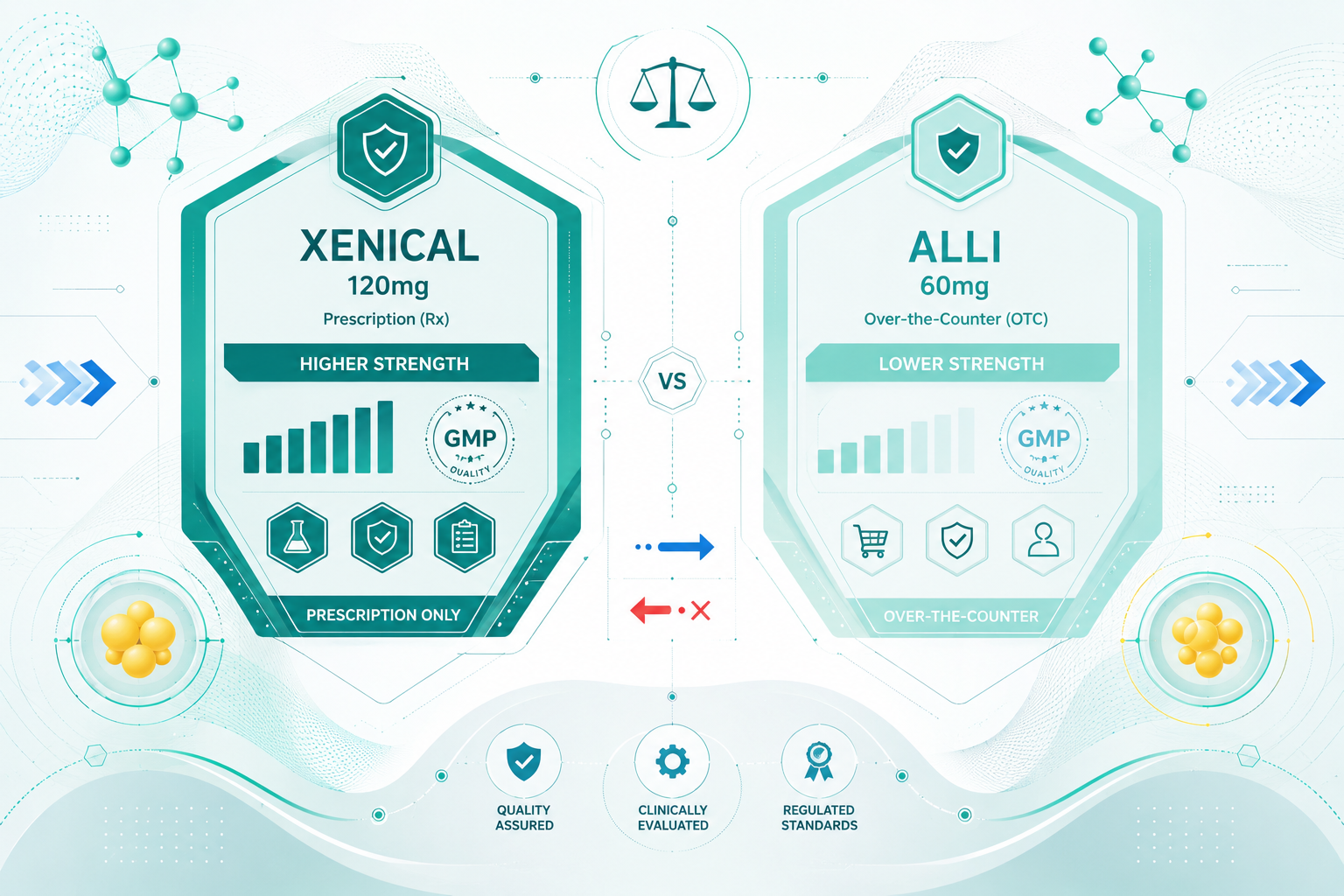
Branded orlistat options include Xenical (120mg, Rx) and Alli (60mg, OTC), alongside multiple generic formulations available across global markets. All versions rely on the same lipase‑inhibition mechanism, producing a localized GI effect with minimal systemic exposure and a consistent PK profile. Differences arise from dose strength (60mg vs 120mg), capsule composition, GI load, fat‑blocking efficiency, food‑linked dosing, long‑term safety data, and manufacturer‑specific formulation nuances. Clinical evidence shows that higher‑dose Rx products deliver stronger fat‑absorption reduction, while OTC versions prioritize accessibility and tolerability. This comparison helps users understand how brand, dosage, and formulation influence efficacy, GI outcomes, and real‑world weight‑loss performance.
The orlistat market is structured around three primary categories: the prescription‑strength Xenical 120mg formulation, the over‑the‑counter Alli 60mg version, and a broad spectrum of generic alternatives available in both 60mg and 120mg strengths. Despite differences in branding, regulatory pathways, and market positioning, all products share the same core mechanism of action—gastrointestinal lipase inhibition—which limits dietary fat absorption and maintains a localized GI effect with minimal systemic exposure.
Variability across brands primarily reflects dosage strength, GI load, formulation quality, and regional regulatory status. Xenical’s 120mg prescription dose is typically associated with stronger fat‑blocking efficiency and a higher likelihood of GI events, while Alli’s 60mg OTC profile emphasizes accessibility and milder tolerability. Generic versions mirror these strengths but differ by manufacturer, excipient composition, and market availability, creating a diverse landscape for consumers seeking cost‑effective options. Understanding how these categories compare helps clarify real‑world efficacy, regulatory distinctions, and practical considerations when choosing between branded and generic orlistat products.
All branded and generic orlistat products rely on the same active molecule—an established gastrointestinal lipase inhibitor that prevents the breakdown and absorption of a portion of dietary fats. Regardless of whether users choose prescription Xenical, OTC Alli, or manufacturer‑specific generics, the underlying mechanism remains identical. This uniformity ensures that fat‑blocking outcomes are primarily driven by dose strength rather than molecular differences.
Orlistat’s action is strictly localized within the gastrointestinal lumen, producing minimal systemic absorption and avoiding systemic metabolic effects. This GI‑restricted behavior is central to its safety profile and explains why all brands demonstrate similar tolerability patterns when matched by dose. The degree of fat‑blocking varies with concentration: higher‑dose 120mg formulations inhibit a larger percentage of dietary fat, while 60mg versions offer milder GI load and more accessible use. Understanding this identical molecular foundation helps clarify why brand differences stem from dosage, formulation quality, and regulatory positioning—not from pharmacodynamic variation.
All orlistat brands—Xenical, Alli, and generics—share an identical pharmacokinetic profile because the drug acts almost exclusively within the gastrointestinal tract. Systemic absorption remains below 1%, meaning circulating concentrations are negligible and do not differ between branded or generic formulations. This GI‑locality ensures that PK parameters such as absorption, distribution, metabolism, and elimination are effectively the same across all versions, as confirmed in structured pharmacokinetics evaluations.
The only meaningful PK‑related variation arises from dosage strength. Higher‑dose 120mg formulations generate stronger fat‑blocking activity and correspondingly higher GI intensity, while 60mg versions maintain a milder profile. These dose‑linked differences also influence stool‑related GI effects, making the choice between OTC and Rx strengths a balance between efficacy and tolerability. The table below summarizes how dose impacts fat‑blocking efficiency and GI load across major brand categories.
| Brand | Dose | Fat Blocking | GI Intensity |
|---|---|---|---|
| Xenical | 120mg | ~25–30% | Higher |
| Alli | 60mg | ~20–25% | Lower |
| Generics | 60mg / 120mg | ~20–30% | Depends on dose |
Clinical evidence consistently demonstrates that prescription‑strength Xenical 120mg delivers the strongest weight‑loss outcomes among all orlistat products. Its higher dose produces more substantial inhibition of dietary fat absorption, resulting in greater cumulative caloric reduction and more pronounced results in structured clinical trials. This makes Xenical the preferred option for patients requiring maximum therapeutic intensity under medical supervision.
Alli 60mg provides moderate efficacy aligned with its OTC positioning. While its fat‑blocking capacity is lower, it remains clinically meaningful for users seeking gradual, accessible weight reduction with fewer GI events. Generic formulations mirror branded products in mechanism and dose‑linked performance, offering comparable outcomes when matched by strength. Across all categories, adherence to meal‑linked dosing and dietary composition plays a crucial role in real‑world efficacy, reinforcing that brand differences are primarily driven by dosage rather than molecular or PK variation.
All orlistat brands—Xenical, Alli, and generics—follow the same fundamental meal‑linked dosing requirement. Because orlistat acts directly on gastrointestinal lipases, each dose must be taken with a fat‑containing meal to ensure effective enzyme inhibition. If a meal contains little or no fat, the dose may be skipped without reducing overall therapeutic benefit. This uniform dosing logic applies across all strengths and formulations.
Dietary fat content significantly influences both efficacy and tolerability. Higher‑fat meals increase the amount of unabsorbed fat in the GI tract, amplifying both fat‑blocking outcomes and stool‑related effects. Prescription Xenical 120mg responds most strongly to high‑fat meals, producing more pronounced results and a higher likelihood of GI intensity. Alli 60mg and generic 60mg versions maintain a milder profile, while 120mg generics mirror Xenical’s dose‑linked behavior. Understanding these food‑linked dynamics is essential for optimizing real‑world outcomes and minimizing predictable food interactions.
Gastrointestinal effects represent the most recognizable aspect of orlistat therapy, and their intensity varies primarily by dose rather than brand. Prescription Xenical 120mg produces the strongest stool‑related GI effects because its higher dose blocks a larger portion of dietary fat, leaving more unabsorbed lipids in the GI tract. This can lead to oily spotting, urgency, and softer stools, especially when meals contain elevated fat levels.
Alli 60mg offers a gentler profile with fewer and milder GI events, making it suitable for users who prefer a more gradual approach to weight reduction. Generic formulations follow the same dose‑dependent pattern: 60mg generics behave like Alli, while 120mg generics align with Xenical’s stronger GI intensity. Across all brands, adherence to meal‑linked dosing and moderation of dietary fat intake significantly reduces the likelihood of side effects. These predictable side effects reflect the drug’s localized mechanism rather than systemic exposure, reinforcing that GI outcomes are driven by dose strength and dietary behavior.
All orlistat brands share a strong safety foundation due to the drug’s GI‑localized mechanism. Because systemic absorption is minimal, systemic risks remain consistently low across Xenical, Alli, and generic formulations. This localized action also explains why long‑term safety profiles are similar across brands, with differences arising mainly from dose‑linked GI intensity rather than pharmacological variation.
One shared consideration is the reduced absorption of fat‑soluble vitamins (A, D, E, K), which occurs uniformly across all strengths and formulations. Users may require supplementation, particularly during extended therapy. Safety distinctions between brands primarily reflect GI load: higher‑dose 120mg products produce stronger stool‑related outcomes, while 60mg versions maintain milder tolerability. Interaction profiles remain consistent across all categories, including effects on cyclosporine levels, warfarin stability, and thyroid hormone absorption, as outlined in drug interactions and contraindications. Overall, safety differences are driven by dose intensity rather than brand identity, reinforcing the predictable nature of orlistat’s side‑effect landscape.
All orlistat brands—Xenical, Alli, and generics—share identical interaction patterns because they rely on the same active molecule and the same GI‑localized mechanism. Key interactions include reduced absorption of fat‑soluble vitamins, altered stability of warfarin due to vitamin K changes, and decreased cyclosporine levels caused by reduced fat absorption. These effects occur uniformly across all formulations and are well‑documented in structured interaction resources.
The main practical difference is dose intensity. Prescription Xenical 120mg produces stronger fat‑blocking activity, which can amplify nutrient‑absorption changes and increase the likelihood of clinically relevant interactions. Alli 60mg and 60mg generics maintain a milder profile, while 120mg generics mirror Xenical’s behavior. Despite these dose‑linked variations, the underlying pharmacokinetic principles remain identical, as confirmed in pharmacokinetics data. Users across all brands should monitor medications affected by fat absorption or vitamin levels.
Long‑term evaluations consistently show that all orlistat brands maintain a stable safety profile over 1–4 years of use. Because orlistat acts locally within the GI tract and exhibits minimal systemic absorption, systemic risks remain low across Xenical, Alli, and generic formulations. This GI‑restricted mechanism explains why long‑term outcomes are similar across brands, with differences arising primarily from dose‑linked tolerability rather than pharmacological variation.
Xenical 120mg demonstrates stronger GI intensity over extended use due to its higher fat‑blocking capacity, which can lead to more frequent stool‑related effects. Alli 60mg offers a gentler long‑term profile, making it easier for many users to maintain adherence. Generic versions follow the same dose‑dependent pattern: 60mg generics behave like Alli, while 120mg generics align with Xenical. Across all categories, sustained efficacy depends on adherence to meal‑linked dosing and dietary moderation, as reflected in structured efficacy and long‑term safety data. Overall, long‑term safety differences reflect dose intensity rather than brand identity.
Each orlistat brand serves a distinct role within weight‑management strategies. Prescription Xenical 120mg is designed for structured clinical weight‑management programs where maximum fat‑blocking intensity is required. Its higher dose delivers stronger therapeutic outcomes and is typically recommended for patients needing medically supervised intervention.
Over‑the‑counter Alli 60mg supports moderate, self‑directed weight control with a focus on accessibility and milder GI intensity. It is suitable for users seeking gradual progress without prescription oversight. Generic formulations mirror branded products in mechanism and dose‑linked behavior, offering equivalent performance when matched by strength. These distinctions help clarify how dosage, regulatory status, and tolerability shape real‑world use cases across the orlistat landscape.
Xenical contains the 120mg prescription dose, offering stronger fat‑blocking and more pronounced GI effects. Alli contains 60mg and is available OTC, providing moderate efficacy with milder tolerability. Both use the same active molecule and mechanism, differing only in dose intensity and regulatory status.
Generic orlistat products use the same active ingredient and mechanism as branded versions. Their efficacy and GI profile match the corresponding dose strength. Differences mainly involve manufacturer quality, excipients, and market availability, but clinical performance remains comparable when doses are equivalent.
Xenical’s 120mg dose blocks the highest percentage of dietary fat, typically around 25–30%. Alli and 60mg generics block approximately 20–25%. Generic 120mg versions match Xenical’s intensity. Fat‑blocking differences are dose‑driven rather than brand‑driven.
Xenical’s higher dose leaves more unabsorbed fat in the GI tract, increasing stool‑related effects such as urgency, oily spotting, and softer stools. Alli and 60mg generics produce milder GI outcomes because they block less fat. GI intensity is directly linked to dose strength and dietary fat intake.
Yes. All orlistat products must be taken with fat‑containing meals to work effectively. The drug acts locally on GI lipases, so dosing without dietary fat provides no benefit. If a meal contains little or no fat, the dose can be skipped without reducing overall therapeutic outcomes.
Yes. All brands share the same pharmacokinetic profile because orlistat acts locally in the GI tract with minimal systemic absorption. Differences arise only from dose strength, which affects GI intensity and fat‑blocking efficiency, not systemic PK behavior.
No. All brands share identical interaction patterns, including effects on fat‑soluble vitamins, cyclosporine levels, and warfarin stability. Higher doses may amplify nutrient‑absorption changes, but the underlying interaction mechanisms remain the same across all formulations.
Yes. All brands demonstrate stable long‑term safety over 1–4 years due to minimal systemic absorption. Xenical shows stronger GI intensity because of its higher dose, while Alli and 60mg generics offer gentler tolerability. Overall safety differences reflect dose strength rather than brand identity.
Higher‑fat meals increase both efficacy and GI effects across all brands. Xenical responds most strongly due to its higher dose, while Alli and 60mg generics produce milder outcomes. Dietary fat content directly influences real‑world tolerability and fat‑blocking performance.
Xenical suits clinical weight‑management programs requiring maximum fat‑blocking intensity. Alli supports moderate, self‑directed weight control with milder GI effects. Generics match branded products in mechanism and dose‑linked performance, offering cost‑effective alternatives for both 60mg and 120mg strengths.