Weight Loss • Lipase Inhibitor • Clinically Proven

Orlistat Pharmacokinetics — GI‑Local Action, Minimal Absorption & Predictable Safety

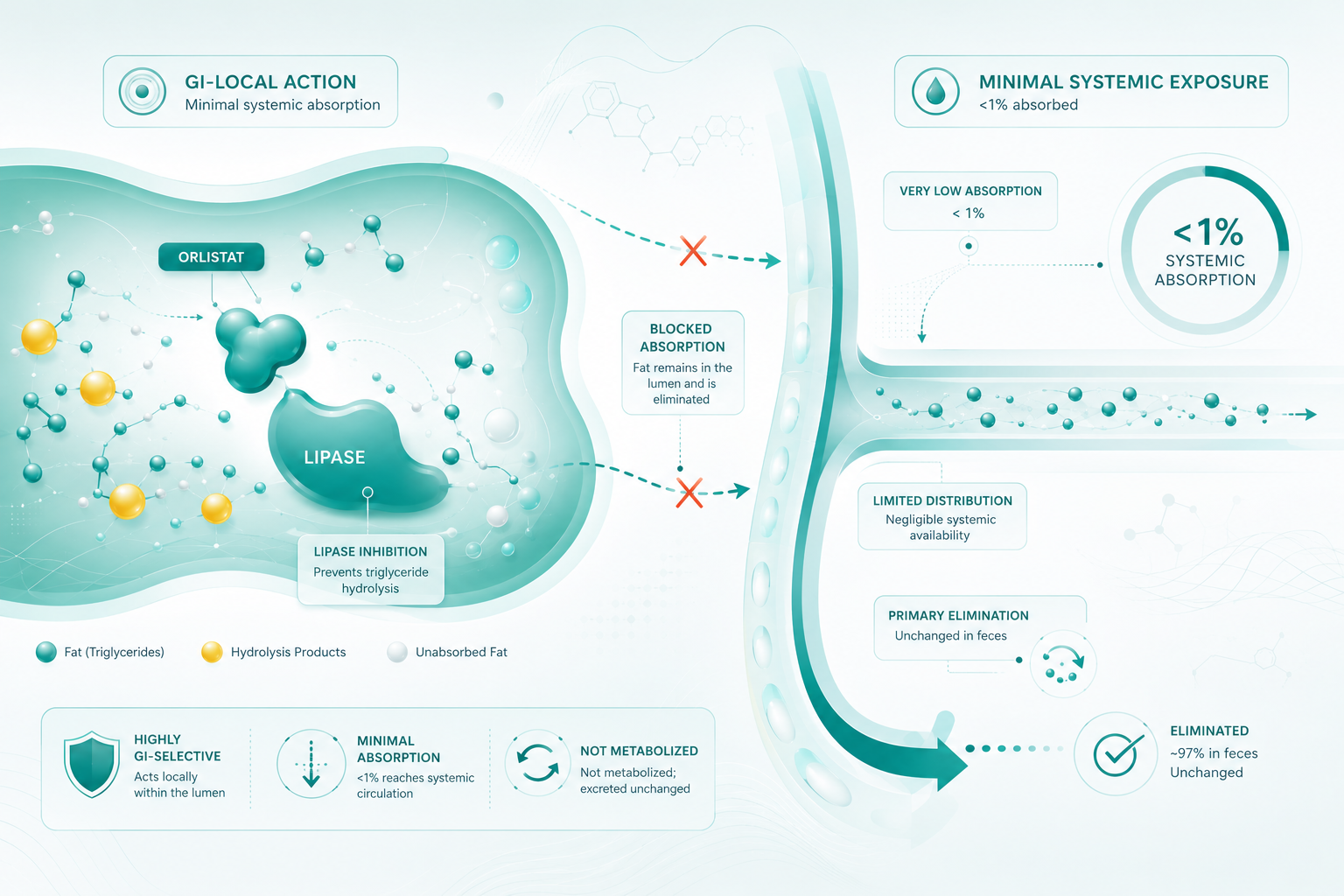
Orlistat features a uniquely localized pharmacokinetic profile: systemic absorption remains below 1%, allowing the drug to act almost entirely within the gastrointestinal tract. This GI‑local behavior limits tissue distribution, minimizes systemic exposure, and explains its strong safety correlation with the underlying mechanism. Orlistat begins working within 1–2 hours, reaches peak activity around 3–4 hours, and maintains lipase inhibition for up to 8 hours, as detailed in Onset & Duration. The drug is excreted primarily unchanged in feces, reinforcing its non‑systemic nature. Differences in PK strength between 60mg and 120mg formulations influence fat‑blocking intensity and GI tolerability, while the localized action underpins predictable, mechanism‑linked side effects rather than systemic reactions.

Absorption: Minimal Systemic Exposure (<1%)
Orlistat Pharmacokinetics

Orlistat demonstrates exceptionally low systemic absorption, with less than 1% of the administered dose entering the bloodstream. This pharmacokinetic profile is central to its therapeutic identity: the drug acts almost entirely within the gastrointestinal lumen, where it binds and inhibits gastric and pancreatic lipases. Because Orlistat does not meaningfully distribute into tissues or circulate systemically, it avoids the broad receptor interactions and metabolic pathways associated with stimulant, hormonal, or centrally acting weight‑loss medications. This localized behavior explains why Orlistat’s safety profile is dominated by predictable GI‑mechanism effects rather than systemic adverse reactions, as outlined in Side Effects and GI Effects.

The minimal systemic exposure also reinforces the mechanistic logic described in Mechanism: unabsorbed fat remains in the digestive tract, producing localized outcomes without affecting cardiovascular, neurological, or endocrine systems. This makes Orlistat fundamentally different from systemic agents, offering a targeted, non‑stimulant, and low‑risk pharmacokinetic profile suitable for long‑term weight‑management strategies.

Parameter Value
Systemic absorption <1%
Primary action site GI lumen
Systemic exposure Negligible

Distribution: GI‑Local Action Only

Orlistat’s distribution profile is uniquely restricted to the gastrointestinal lumen, where it performs its lipase‑inhibiting activity without entering systemic circulation. Because the drug is not absorbed into plasma in meaningful quantities, it does not distribute into peripheral tissues, organs, or the central nervous system. This absence of CNS penetration eliminates stimulant‑like or neuroactive effects, reinforcing the purely peripheral nature of Orlistat’s therapeutic action.

The lack of systemic distribution also prevents plasma accumulation, even during long‑term use, supporting the favorable safety profile described in Long‑Term Safety. These characteristics directly reflect the drug’s underlying mechanism: Orlistat remains confined to the GI tract, interacting only with dietary fat and digestive enzymes. This localized distribution makes Orlistat fundamentally different from systemic weight‑loss agents and contributes to its predictable tolerability.

Metabolism & Excretion

Orlistat undergoes minimal metabolic conversion, with the majority of the administered dose remaining unchanged throughout the digestive tract. Approximately 97% of the drug is excreted via feces, reflecting its GI‑local mechanism and negligible systemic absorption. Only a very small fraction of metabolites—typically less than 2%—is eliminated through renal pathways. This excretion pattern is clinically important for patients with hepatic or renal impairment, as limited systemic exposure reduces the burden on both liver and kidney clearance mechanisms.

Because Orlistat does not rely on hepatic biotransformation or renal filtration for the majority of its elimination, it avoids the interaction risks commonly associated with systemically metabolized medications. This is particularly relevant when evaluating Contraindications and potential Interactions, ensuring that Orlistat remains a suitable option for a wide range of patients. Its minimal metabolism reinforces the drug’s predictable, mechanism‑driven pharmacokinetic profile.

Route Percentage
Fecal excretion ~97%
Renal excretion <2%
Metabolic conversion Minimal

Onset & Duration (PK Perspective)

From a pharmacokinetic standpoint, Orlistat begins exerting its lipase‑inhibiting action within 1–2 hours after ingestion, aligning with the arrival of dietary fats in the stomach and small intestine. Peak activity occurs around 3–4 hours, corresponding to the period of maximal digestive lipase exposure. This timing is essential for understanding how Orlistat interacts with meal patterns and dosing schedules.

The duration of action extends up to 8 hours, providing sustained enzyme inhibition throughout the digestive window of typical meals. This predictable PK timeline supports the dosing logic described in Dosing and is further detailed in Onset & Duration. By maintaining consistent lipase suppression, Orlistat ensures stable fat‑blocking performance across meals, reinforcing its role as a structured, mechanism‑driven weight‑management therapy.

Food Interaction & PK Variability

Orlistat’s pharmacokinetic behavior is tightly linked to dietary fat intake. Because the drug inhibits gastric and pancreatic lipase, it requires the presence of triglycerides to activate its mechanism. When taken with meals containing dietary fat, Orlistat binds to luminal lipases and prevents fat hydrolysis, producing predictable PK outcomes. Without fat, the drug has nothing to inhibit, resulting in negligible mechanistic activity. This explains why Orlistat must be taken with food and why high‑fat meals amplify both efficacy and GI‑mechanism reactions, as described in Food Interaction.

Variability in PK response is therefore driven by meal composition rather than systemic absorption. Higher fat levels increase the amount of unprocessed triglycerides moving through the GI tract, intensifying mechanism‑linked outcomes such as oily stools and urgency, detailed in GI Effects. Conversely, low‑fat meals reduce both fat‑blocking intensity and GI reactions. This meal‑dependent PK profile makes dietary planning essential for optimizing Orlistat’s therapeutic performance.

PK Differences: 60mg vs 120mg

The pharmacokinetic differences between Orlistat 60mg and 120mg formulations arise from the strength of lipase inhibition rather than systemic exposure. Both doses remain confined to the GI lumen, but the 120mg prescription version provides stronger and more consistent enzyme blockade. This results in higher fat‑blocking efficiency and more pronounced mechanistic outcomes compared to the OTC 60mg dose.

Because stronger inhibition produces more unabsorbed fat, the 120mg formulation may also generate more noticeable GI‑mechanism effects, especially with high‑fat meals. The 60mg version offers a gentler PK profile with fewer GI reactions, making it suitable for users seeking lower‑intensity therapy. A full comparison of both doses is available in 120mg and Brand Comparison, highlighting how PK strength influences clinical efficacy and tolerability.

PK Differences: Xenical vs Alli

Xenical and Alli share an identical pharmacokinetic model: both act locally within the GI tract, exhibit minimal systemic absorption, and follow the same distribution, metabolism, and excretion pathways. The PK profile remains unchanged because the underlying mechanism—lipase inhibition—does not vary between brands.

The only meaningful difference is dosage. Prescription Xenical contains 120mg of Orlistat, producing stronger lipase inhibition and higher fat‑blocking consistency. OTC Alli contains 60mg, resulting in milder PK intensity and fewer GI‑mechanism reactions. Despite these differences in strength, the PK architecture remains identical across both products, as detailed in Alli vs Xenical. This consistency ensures predictable behavior regardless of brand choice.

PK → Safety & GI Effects

Orlistat’s pharmacokinetic profile directly explains its characteristic GI effects. Because the drug is minimally absorbed and remains confined to the gastrointestinal lumen, its entire activity is focused on blocking lipase‑mediated fat hydrolysis. Unprocessed triglycerides continue through the digestive tract, increasing stool lipid content and producing oily spotting, urgency, and flatulence. These outcomes are mechanistic rather than toxic, reflecting predictable consequences of fat malabsorption rather than systemic intolerance, as outlined in Side Effects and GI Effects.

The absence of systemic distribution explains why Orlistat does not cause cardiovascular, endocrine, or neurological adverse reactions typical of systemic weight‑loss agents. PK also clarifies why dietary adjustments matter: high‑fat meals increase the amount of unabsorbed fat, amplifying GI reactions, while low‑fat meals reduce both intensity and frequency. Structured dietary planning, described in Food Interaction, helps maintain tolerability while preserving Orlistat’s fat‑blocking efficiency.

PK vs Other Weight‑Loss Agents

Orlistat’s pharmacokinetic profile is fundamentally different from systemic weight‑loss medications. GLP‑1 agents such as semaglutide rely on systemic absorption, broad hormonal modulation, and multi‑organ distribution to regulate appetite, glucose pathways, and gastric emptying. In contrast, Orlistat remains entirely within the GI lumen, acting only on dietary fat without influencing metabolic or endocrine systems. A detailed comparison is available in Orlistat vs Semaglutide.

Phentermine represents another mechanistically distinct category: a centrally acting stimulant that increases catecholamine activity to suppress appetite. Its PK profile involves CNS penetration and systemic distribution—features Orlistat completely lacks. As outlined in Orlistat vs Phentermine, Orlistat is the only clinically used GI‑local lipase inhibitor, offering a non‑stimulant, non‑systemic alternative focused solely on reducing fat absorption rather than altering appetite or neurochemical pathways.

Orlistat (Xenical) FAQ

How much orlistat is absorbed into the bloodstream?

Less than 1% of an orlistat dose enters systemic circulation. Because absorption is minimal, the drug remains almost entirely within the GI tract, acting locally on digestive enzymes without producing systemic hormonal, cardiovascular, or neurological effects.

Why does orlistat act only in the GI tract?

Orlistat’s chemical structure prevents meaningful absorption, keeping it confined to the GI lumen. This allows it to interact only with gastric and pancreatic lipases, blocking fat breakdown without affecting tissues, organs, or the central nervous system.

How long does orlistat stay active after a dose?

Orlistat begins working within 1–2 hours, reaches peak activity around 3–4 hours, and maintains lipase inhibition for up to 8 hours. This duration aligns with typical digestion cycles and supports consistent fat‑blocking across meals.

Does food affect orlistat’s pharmacokinetics?

Yes. Orlistat requires dietary fat to activate its mechanism. Without fat, lipase inhibition is minimal. Higher‑fat meals increase fat‑blocking intensity and GI reactions, while low‑fat meals reduce both effects and improve tolerability.

Are PK profiles different for Alli and Xenical?

No. Both products share the same GI‑local pharmacokinetic model. The only difference is dosage: Xenical provides 120mg for stronger inhibition, while Alli contains 60mg for milder, OTC‑level activity. PK behavior remains identical across both.

How is orlistat eliminated from the body?

Most of the drug—around 97%—is excreted unchanged in feces. Less than 2% is eliminated through renal pathways. Minimal metabolism and low systemic exposure reduce the burden on liver and kidney clearance systems.

Why does orlistat cause GI side effects?

GI effects occur because unabsorbed dietary fat remains in the digestive tract. When fat intake is high, more unprocessed lipids reach the colon, causing oily stools, urgency, and flatulence. Adjusting meal fat content helps reduce these reactions.

How does orlistat’s PK compare to GLP‑1 drugs?

Orlistat acts only in the GI lumen and is not systemically absorbed. GLP‑1 drugs rely on full systemic distribution, hormonal modulation, and multi‑organ activity. Orlistat remains the only non‑systemic, GI‑local lipase inhibitor used for weight management.

FDA Label (Xenical) Clinical PK Studies (PubMed)