Weight Loss • Lipase Inhibitor • Clinically Proven

Orlistat Mechanism of Action — Lipase Inhibition & GI‑Local Fat Blocking

Orlistat works by inhibiting gastric and pancreatic lipase, preventing the breakdown and absorption of dietary fats and reducing total caloric intake. This GI‑local mechanism— with no systemic absorption—explains its predictable safety profile, characteristic GI side effects, and the dose‑dependent fat‑blocking seen in 60mg OTC and 120mg prescription formulations. By reducing fat absorption by ~25–30%, Orlistat provides a clinically validated, non‑stimulant pathway to weight loss. Learn how its targeted action compares to other fat‑blocking approaches in Fat Blocking and explore its pharmacodynamic behavior in Pharmacokinetics.

Core Mechanism: Lipase Inhibition
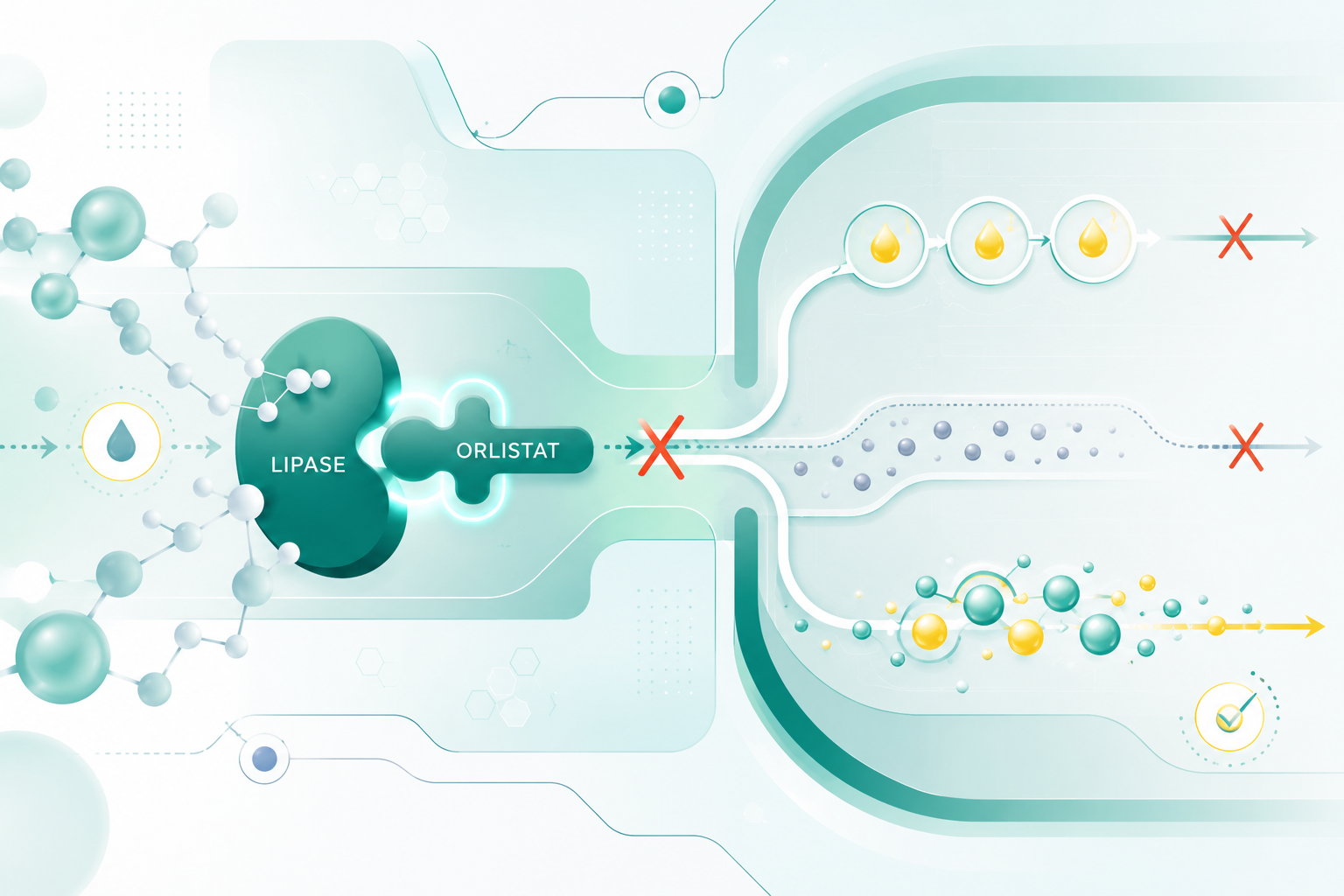
Orlistat Mechanism of Action

Orlistat’s fundamental mechanism is based on potent inhibition of both gastric and pancreatic lipase—key enzymes responsible for hydrolyzing dietary triglycerides into absorbable free fatty acids. By forming a covalent bond with active‑site serine residues, Orlistat effectively inactivates these lipases, resulting in a substantial reduction in triglyceride breakdown. This biochemical blockade leads to a measurable decrease in fat absorption, typically around 25–30%, making Orlistat one of the most targeted fat‑blocking agents available.

Because Orlistat acts exclusively within the lumen of the gastrointestinal tract, it exhibits minimal systemic exposure—an important factor behind its predictable safety profile and mechanism‑linked GI effects. The drug’s local action also explains its consistent pharmacodynamic behavior across dosing regimens, which is detailed further in Pharmacokinetics. The unabsorbed fat is ultimately excreted, reinforcing Orlistat’s role as a non‑stimulant, mechanism‑driven weight‑management therapy.

Step Mechanistic Effect
Lipase binding Enzyme inactivation
Triglyceride hydrolysis block Reduced free fatty acids
GI-local action No systemic absorption
Fat excretion Increased fecal fat

GI‑Local Action & Minimal Absorption

Orlistat operates exclusively within the gastrointestinal lumen, where it binds and inactivates gastric and pancreatic lipases without entering systemic circulation. This GI‑local confinement is a defining pharmacological characteristic: less than 1% of the drug is absorbed, as confirmed in Pharmacokinetics. Because Orlistat remains in the digestive tract, its mechanistic effects are limited to the processing of dietary fats, avoiding systemic receptor interactions and metabolic pathways that typically contribute to whole‑body adverse reactions.

The near‑absence of systemic exposure explains why Orlistat’s safety profile is dominated by mechanism‑linked gastrointestinal reactions rather than cardiovascular, neurological, or endocrine side effects. Unabsorbed fat moves through the GI tract, producing predictable outcomes such as oily stools or urgency—effects described in Side Effects. This localized mechanism makes Orlistat fundamentally different from systemic weight‑loss agents, offering a targeted, non‑stimulant, and low‑risk therapeutic pathway for reducing caloric intake.

Fat Blocking Efficiency (25–30%)

Orlistat consistently reduces dietary fat absorption by approximately 25–30%, making it one of the most predictable non‑systemic weight‑management agents. This efficiency is tightly linked to the amount of fat present in meals: the drug blocks only the triglycerides that require lipase‑mediated hydrolysis, meaning low‑fat meals produce minimal mechanistic impact. As dietary fat increases, Orlistat’s inhibitory effect becomes more pronounced, reaching its upper range of efficiency.

The degree of fat blocking also correlates with dosage. The OTC 60mg version provides moderate inhibition suitable for daily use, while the prescription 120mg dose delivers maximal lipase suppression and higher fat‑blocking consistency. Meal composition plays a central role, as detailed in Food Interaction, reinforcing the importance of structured dietary planning to optimize Orlistat’s mechanistic benefits.

Diet Fat Level Expected Fat Blocking
Low-fat Minimal effect
Moderate-fat ~25% reduction
High-fat Up to 30% reduction

Onset & Duration of Mechanistic Action

Orlistat begins exerting its mechanistic effect within 1–2 hours after ingestion, coinciding with the arrival of dietary fats in the stomach and small intestine. As lipase enzymes become exposed to the inhibitor, the drug reaches peak mechanistic activity at approximately 3–4 hours, aligning with the period of maximal triglyceride hydrolysis during digestion. This timing is essential for understanding how Orlistat interacts with meal patterns and dosing schedules.

The duration of action extends up to 8 hours, providing sustained lipase inhibition throughout the digestive window of a typical meal cycle. This predictable timeline is detailed in Onset & Duration and informs optimal dosing strategies described in Dosing. By maintaining consistent enzyme suppression across meals, Orlistat ensures stable fat‑blocking performance and supports structured caloric reduction throughout the day.

Mechanism → GI Side Effects

Orlistat’s GI‑related side effects arise directly from its core mechanism: inhibition of gastric and pancreatic lipases prevents dietary triglycerides from being hydrolyzed into absorbable fatty acids. As a result, unprocessed fat remains in the intestinal lumen and moves through the digestive tract unchanged. This unabsorbed fat increases stool lipid content, producing oily spotting, steatorrhea, and occasional urgency—effects thoroughly detailed in GI Effects and Side Effects. Because the drug acts locally and is not systemically absorbed, these reactions are mechanistic rather than toxic, reflecting the predictable consequences of fat malabsorption rather than systemic intolerance.

The intensity of GI symptoms is strongly dependent on dietary fat levels. High‑fat meals generate more unabsorbed triglycerides, amplifying oily stools and flatulence, while low‑fat meals minimize these outcomes. This relationship is explained further in Food Interaction, emphasizing the importance of structured dietary adjustments. Reducing fat intake, distributing fat more evenly across meals, and avoiding large high‑fat portions can significantly moderate GI effects while preserving Orlistat’s therapeutic fat‑blocking efficiency.

Mechanism Differences: Xenical vs Alli

Xenical and Alli share an identical mechanism of action: both inhibit gastric and pancreatic lipase, reducing dietary fat absorption through the same GI‑local pathway. The key distinction lies in dosage. Prescription Xenical delivers 120mg of Orlistat per capsule, providing maximal lipase inhibition and the highest degree of fat‑blocking consistency. In contrast, OTC Alli contains 60mg—half the strength—resulting in a milder but still clinically meaningful reduction in fat absorption.

These dosage differences translate into varying fat‑blocking efficiency and GI‑side‑effect intensity. Xenical’s stronger inhibition produces more robust caloric reduction but may also lead to more noticeable mechanism‑linked GI reactions when dietary fat is high. Alli offers a gentler entry point for users seeking a lower‑intensity regimen. A full comparison of brand‑level differences is available in Brand Comparison, helping users understand how dosage influences mechanistic strength and overall tolerability.

Mechanism vs Other Weight‑Loss Agents

Orlistat is unique among weight‑loss medications because it acts exclusively through lipase inhibition, blocking the breakdown and absorption of dietary fat. This contrasts sharply with GLP‑1‑based agents such as semaglutide, which modulate appetite, gastric emptying, and glucose regulation through systemic hormonal pathways. A detailed comparison is available in Orlistat vs Semaglutide, highlighting how Orlistat’s GI‑local mechanism avoids systemic metabolic effects.

Phentermine represents another mechanistically distinct category: a central nervous system stimulant that suppresses appetite by increasing catecholamine activity. Unlike phentermine, Orlistat does not influence hunger, mood, or cardiovascular parameters, as outlined in Orlistat vs Phentermine. Its purely peripheral, non‑stimulant mechanism makes Orlistat the only clinically used lipase inhibitor, offering a targeted approach focused solely on reducing caloric intake through fat malabsorption rather than altering appetite or systemic metabolism.

Orlistat (Xenical) FAQ

How does orlistat block dietary fat?

Orlistat inhibits gastric and pancreatic lipase, preventing triglycerides from being broken down into absorbable fatty acids. Because the fat remains unprocessed, it passes through the digestive tract and is excreted, reducing overall caloric intake and supporting structured weight‑loss programs.

Does orlistat enter the bloodstream?

Systemic absorption of orlistat is extremely low—typically under 1%. The drug acts locally within the gastrointestinal tract, which is why it does not produce systemic stimulant or hormonal effects and has a safety profile dominated by predictable GI‑mechanism reactions.

Why does orlistat cause GI side effects?

GI effects occur because unabsorbed dietary fat remains in the intestinal lumen. When fat intake is high, more unprocessed lipids reach the colon, leading to oily stools, urgency, and flatulence. Adjusting meal fat content helps reduce these mechanism‑linked reactions.

Is the mechanism the same for Alli and Xenical?

Yes. Both Alli and Xenical work through identical lipase inhibition. The difference lies in dosage: Xenical provides 120mg for stronger fat blocking, while Alli contains 60mg for milder, OTC‑level inhibition. Mechanistic action remains the same across both formulations.

How much fat does orlistat typically block?

Orlistat blocks roughly 25–30% of dietary fat, depending on meal composition. Higher‑fat meals produce stronger inhibition because more triglycerides require lipase activity. Lower‑fat meals result in milder effects and fewer GI reactions.

Does orlistat work with low‑fat diets?

Yes, but the fat‑blocking effect is naturally smaller because less dietary fat is available for lipase inhibition. Low‑fat diets improve tolerability and reduce GI reactions while still supporting calorie reduction through structured eating habits.

How long does the mechanism stay active?

Orlistat begins working within 1–2 hours, reaches peak activity around 3–4 hours, and maintains lipase inhibition for up to 8 hours. This timeline aligns with typical digestion cycles and supports consistent fat‑blocking across meals.

How does orlistat’s mechanism compare to GLP‑1 drugs?

Orlistat acts only in the GI tract by blocking fat absorption, while GLP‑1 drugs regulate appetite, glucose pathways, and gastric emptying through systemic hormonal signaling. Orlistat remains the only non‑systemic lipase inhibitor used for weight management.

FDA Label (Xenical) EMA Assessment Pharmacology Textbooks / PubMed